
Most of us have at least one piece of jewellery we no longer wear: a ring that doesn't fit your style, a broken chain, a single earring, or a treasured heirloom that stays in a drawer because it doesn't feel like "you".
The good news is that old jewellery rarely has to stay hidden. In 2027 you have more options than ever, from giving it a completely new design to trading in the gold or passing it on. This guide walks you through seven practical options, so you can decide what suits your pieces, your budget and the memories attached to them.
The short answer: if you have old jewellery you don't wear, your best options are to remodel it into a new design, reset the gemstones as a pendant or earrings, trade in the gold, repair it, pass it on, or store it safely. The right choice depends on whether the value to you is sentimental, financial or both.
Before You Decide: Find Out What You Have
A little knowledge makes every option easier. Before you choose, take a few simple steps:
Check for hallmarks. Tiny stamps inside a ring band or on a clasp show the metal and its purity, for example 9ct, 18ct or 950 platinum.
Sort your pieces. Separate whole pieces, broken pieces and loose gemstones.
Take clear photos. Good photographs help any jeweller give useful advice without seeing the piece in person.
Note the story. Who owned it, and what does it mean to you? This often decides which option feels right.
Gold prices move, so the value of old gold can change from month to month. A professional assessment will give you a true picture of both the metal and your gemstones.
7 Things You Can Do With Old Jewellery
1. Remodel it into something you will wear
If you love the gemstones or the gold but not the design, remodelling is often the most rewarding option. A skilled jeweller can reset your gemstones into a modern design and reuse your existing metal, so the new piece carries the same history in a style you will actually wear. See our guide to how much jewellery remodelling costs in the UK for a realistic idea of budget.
Best for: inherited pieces, outdated designs, and jewellery with sentimental value.
2. Turn a ring you don't wear into a pendant or earrings
A ring that sits in a box can become a pendant you wear every day. Gemstones from rings can also be reset as earrings, which suit almost every outfit and rarely need resizing. Read more in how to turn an unworn ring into a modern pendant or earrings.
Best for: rings that no longer fit, or rings you love but rarely wear.
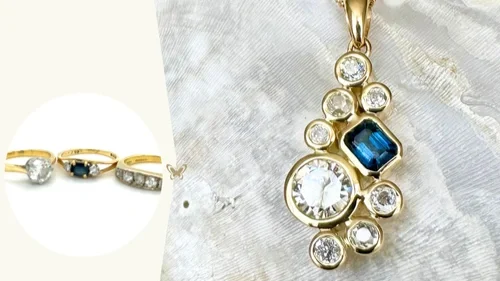
3. Combine several pieces into one
If you have inherited more than one ring, or have a small collection of odd earrings and broken chains, you can bring the gemstones and gold together into a single, meaningful design. It is a lovely way to honour more than one person or memory. Our guide to combining multiple inherited rings into one stunning piece explains how it works.
Best for: families with several small heirlooms, or pieces from different eras.
4. Trade in or sell the gold
If a piece is damaged, unwanted or purely of financial value, you can sell the gold or trade it in. Trading it towards a new piece is often more cost-effective than selling for cash, because the value goes directly against your new design. Always ask how the gold will be tested and weighed, and get a clear written quote first. Read can you melt down your own gold to make new jewellery? to understand your options.
Best for: broken jewellery, single earrings, and gold you have no emotional attachment to.
5. Repair and restore it
Sometimes the answer is simply to fix what you have. A loose gemstone, a worn clasp or a thin ring shank can often be repaired, cleaned and polished, bringing a favourite piece back to life without changing it.
Best for: pieces you still love in their original form.
6. Pass it on or divide it within the family
If the jewellery means a great deal but doesn't suit you, it may be a gift for a daughter, granddaughter or friend. Where pieces are shared between relatives, a remodel can also split gemstones into matching pieces. If guilt is holding you back, read is it wrong to remodel inherited jewellery?
Best for: treasured heirlooms with a clear person in mind.
7. Store it safely, or donate it
If you are not ready to decide, there is no rush. Keep jewellery in a dry, soft pouch, away from other pieces, and check that it is covered by your home insurance. and check that it is covered under your insurance (if covered under a home insurance policy, please check you are fully covered. We always recommend specialist jewellery and watch insurance for sentimental and important pieces). If you would like others to benefit, charity shops often accept jewellery donations, and many run Gift Aid schemes so the charity can claim extra on the sale (check with the charity first).
Best for: anything you are undecided about, or pieces with little personal meaning.
How the UK Hallmarking Rules Protect You
In the UK, items sold as gold, silver, platinum or palladium must carry a hallmark from an assay office once they weigh more than a legal minimum: 1g for gold, 7.78g for silver, 0.5g for platinum and 1g for palladium. A hallmark is independent proof of the metal and its purity, and it is a good first thing to look for on any old piece.
A few useful points:
Very old or heavily worn pieces may have faint or missing hallmarks, so a jeweller can test the metal to confirm what it is.
Reputable jewellers send new pieces that need one to an assay office, so you can trust what you are given.
You can learn more about the rules from the British Hallmarking Council and the assay offices.
Why You Can Trust Legacy Jewellery With Your Pieces
Old jewellery is often irreplaceable, so we treat it that way:
Written quote first. You see a clear price before any work begins.
Logged and photographed. Every piece and gemstone is recorded and photographed when it arrives, in our studio.
Tracked and insured postage. Remote clients send and receive their jewellery in tracked, insured packs. See how postal remodelling works.
A clear timeline. Most projects take around 6 to 9 weeks from first call to final piece.
Proof you can check. [Add: trade body membership, number of reviews and rating, link to your reviews page.]
What Happens on Your Discovery Call
You tell Sarah about your pieces and what you would love them to become.
You get honest guidance on options, rough costs and timing, including when to keep a piece as it is.
You decide with no obligation. If you would like to go ahead, you receive a written quote.
FAQs
-
You can remodel it into a new design, turn it into a pendant or earrings, trade in the gold, repair it, pass it on to family, or store it safely until you are ready to decide.
-
It depends on how you feel about the piece. Selling releases the value of the metal, while remodelling keeps your gemstones and memories in a design you will wear. Many people trade in some gold to offset the cost of a remodel.
-
Yes. Old gold can usually be tested, refined and reused, or traded in towards your new piece.
-
Not at all. Many families find that wearing a loved one's jewellery in a new design keeps its memory alive far better than leaving it in a drawer.
-
Yes. Remote and postal remodelling is available across the UK, with tracked and insured postage. See how remote and postal jewellery remodelling works.
